As enterprises start handing real work to AI agents, one question decides everything: can you trust what the AI gives back? The answer depends less on model size and more on what it was trained on.
SAP Domain Models are SAP’s response: AI trained on SAP’s own knowledge rather than the open internet, so its answers are grounded in your business instead of guessed at.
So what are SAP Domain Models, and why do they beat generic LLMs for enterprise work? Because a model that understands your processes, data model, and code produces accurate, compliant, auditable results, exactly what a generic chatbot can’t guarantee. Here’s the practical difference, and why it matters in 2026.
What Are SAP Domain Models?
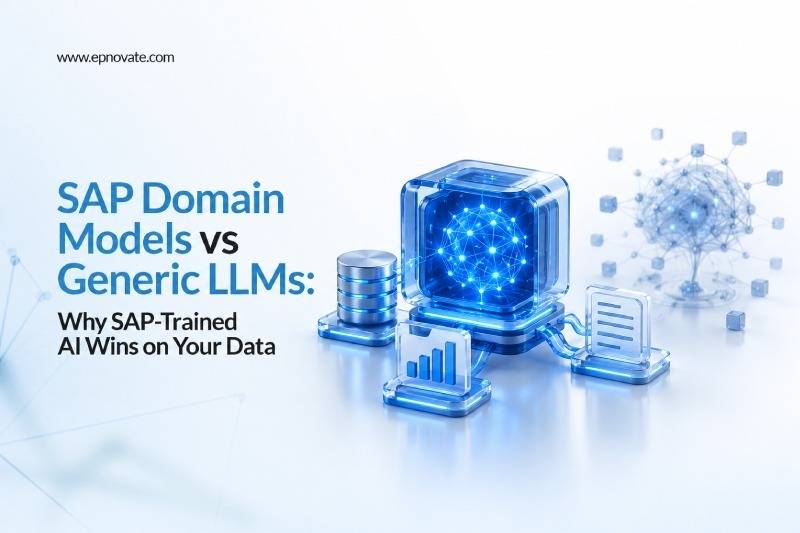
SAP Domain Models are AI models trained specifically on SAP domain knowledge, code, data, metadata, business processes, architectural knowledge, and documentation. Instead of answering from generic internet content, they ground their output in your real SAP context.
That grounding is the whole point. When you ask a question or generate code, the model draws on how SAP actually works — not a plausible-sounding average of everything on the web. These models are the intelligence feeding SAP Business AI across Joule, Joule Studio, and Joule Agents, giving the assistant and the agents a reliable foundation to act on.
Generic LLMs vs SAP Domain Models: The Core Difference
A generic LLM is broad but shallow on your business. A domain model is narrower but deep and grounded where it counts.
| Dimension | Generic LLM | SAP Domain Models |
| Business context | General web knowledge; no view of your SAP setup | Trained on SAP processes, data model, and architecture |
| Accuracy on SAP tasks | Plausible but often wrong on specifics | Grounded in real SAP context |
| Code quality | May suggest non-standard, risky code | Generates clean-core-compliant code |
| Data privacy | Risk when business data leaves the environment | Operates within SAP’s governed environment |
| Hallucination risk | High on business-specific questions | Reduced by grounding in SAP knowledge |
Why Generic LLMs Fall Short for SAP Work
For casual tasks, a general chatbot is fine. For enterprise SAP work, the gaps get expensive:
- Hallucinations on business-specific questions: Confident answers that don’t match how your system actually works.
- No understanding of your processes or data model: It can’t reason about objects, flows, and relationships it was never trained on.
- No clean-core awareness: Code suggestions that break upgrade-safety and create technical debt.
- Data-privacy and governance gaps: Sending business data to an external model raises real compliance risk.
Where SAP Domain Models Show Up in Practice
This isn’t theory; the models already power concrete capabilities in SAP Business AI:
- Clean-core-compliant code generation: In Joule Studio, developers describe what they need in natural language and get code that respects clean-core standards, rather than custom work that complicates the next upgrade.
- Grounded natural-language queries: Users ask questions in plain language and get answers tied to the real underlying data model and business context, not a generic guess.
- More reliable, auditable agent actions: Because Joule Agents reason on SAP-grounded models, their decisions are more trustworthy and easier to trace.
What This Means for Your Business
The payoff of grounded enterprise AI shows up where leaders feel it:
- Higher-accuracy outputs with far less rework: Fewer wrong answers to catch and correct.
- Safer, standards-compliant development: Custom extensions that don’t jeopardize upgrades.
- Faster build cycles: Natural-language-to-clean-code shortens how long extensions and agents take to ship.
- Trustworthy agents: Because the model knows SAP, not just the internet, you can let agents act with more confidence.
The Catch: Domain Models Need a Modern, Clean Foundation
Grounded AI only delivers its edge when there’s something solid to ground it in. SAP Domain Models assume a modern core, S/4HANA plus clean, governed data. On legacy ECC, with messy or duplicated master data, even the best model has a weak foundation to reason from, and the accuracy advantage shrinks.
That’s why getting AI-ready and getting migration-ready are the same project. A move to S/4HANA and a clean-core, well-governed data layer are what let these models, and the agents built on them, perform as intended. Treat the AI ambition and the foundation work as one program, not two.
Conclusion
For SAP work, a model grounded in your business beats a bigger, generic one every time, but the foundation is what unlocks it. S/4HANA and clean, governed data turn SAP Domain Models from a promising feature into a dependable advantage.
Epnovate has delivered SAP implementation and support since 2016, with 55+ developers, 100+ clients served, and a 4.9/5 client rating as a Trusted SAP Partner, the depth to pair your Business AI ambitions with a solid, upgrade-safe foundation. Explore our SAP implementation services, or book a free consultation to plan your Business AI foundation.
Frequently Asked Questions
What are SAP Domain Models?
SAP Domain Models are AI models trained on SAP-specific knowledge, code, data, metadata, business processes, architecture, and documentation, so their output is grounded in real SAP context instead of generic internet knowledge. They power SAP Business AI across Joule, Joule Studio, and Joule Agents.
How are SAP Domain Models different from ChatGPT or other LLMs?
Generic LLMs are trained broadly on public data and have no view of your SAP environment. SAP Domain Models are trained on SAP knowledge, so they’re more accurate on business-specific tasks, generate clean-core-compliant code, and operate within SAP’s governed environment.
Do SAP Domain Models reduce AI hallucinations?
Yes. By grounding answers in SAP’s actual processes, data model, and documentation, these models reduce the business-specific hallucinations that generic LLMs are prone to, which is critical when AI agents act on real data.
Where are SAP Domain Models used?
They provide the intelligence behind Joule, Joule Studio, and Joule Agents, including clean-core-compliant code generation from natural language and grounded natural-language queries against your real data model.
Do I need S/4HANA to benefit from SAP Domain Models?
In practice, yes. Their advantage depends on a modern core and clean, governed data. On legacy ECC with messy data, the grounding, and therefore the accuracy benefit, is limited, which is why migration and AI-readiness go hand in hand.