Every enterprise running SAP is sitting on a goldmine it rarely taps: years of clean, structured process data across finance, supply chain, procurement, and HR. AI is how you finally put that data to work.
SAP AI use cases turn everyday transactions, invoices, purchase orders, and maintenance logs into predictions, recommendations, and automated actions.
So what are SAP AI use cases? They’re the specific business processes where SAP’s built-in artificial intelligence removes manual effort, catches problems early, and speeds up decisions.
What Is SAP Business AI?
SAP Business AI isn’t a bolt-on chatbot. Generic AI tools sit outside your systems and need data piped in; SAP Business AI is embedded directly inside the applications where your work already happens, so it acts on live, governed business data with full context.
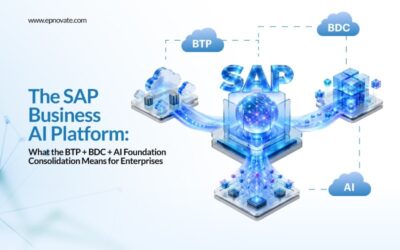
At its center is Joule, SAP’s generative AI copilot that lets users ask questions and trigger tasks in plain language. SAP Business AI runs across the suite: S/4HANA for core operations, SuccessFactors for HR, Ariba for procurement, and SAP BTP as the platform that ties custom AI extensions together.
Why Enterprises Are Adopting AI in SAP
The pull toward AI in SAP comes down to three realities. First, the data is already there, structured, validated, and sitting inside SAP, so there’s no messy data-lake project before you see value. Second, the pressure is relentless: leaders want lower cost, faster cycle times, and fewer errors, all at once. Third, and most important for planning, the strongest AI features are native to S/4HANA. Enterprises still on ECC simply can’t access them, which quietly turns “adopt AI” into “modernize your core first.
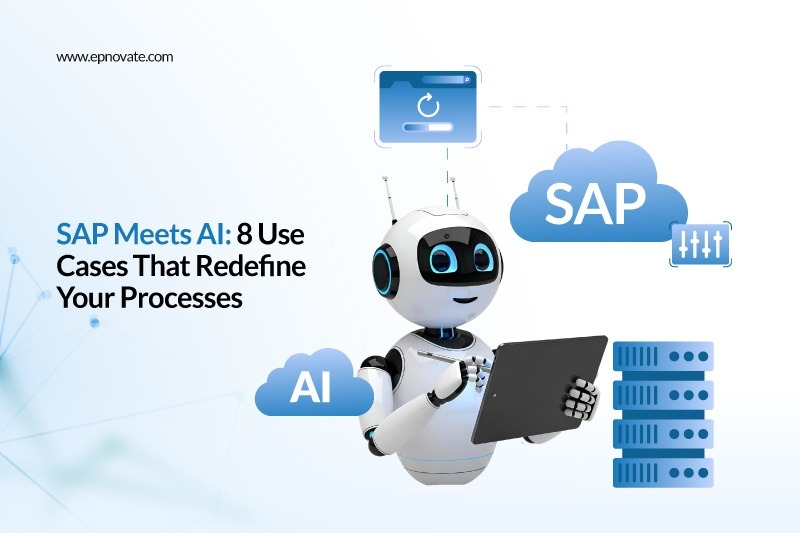
8 SAP AI Use Cases That Redefine Your Processes
These are the processes where SAP AI use cases deliver the clearest return.
Intelligent invoice & payment matching (Finance)
AI reads incoming invoices, matches them to purchase orders and goods receipts, and clears the routine ones automatically, cutting manual AP work and late-payment penalties.
Cash-flow forecasting & anomaly detection
Models learn your payment patterns to forecast cash positions and flag unusual transactions before they become write-offs or fraud.
Demand forecasting & inventory optimization (Supply Chain)
AI blends history, seasonality, and demand signals to predict more accurately, so you hold less safety stock without risking stockouts.
Predictive maintenance (Manufacturing / Assets)
Sensor and equipment data feed models that predict failures ahead of time, shifting maintenance from reactive to planned and reducing downtime.
AI-assisted procurement & supplier risk scoring
Within Ariba, AI recommends sources, spots maverick spend, and scores suppliers on risk so buyers act on evidence, not gut.
Smart ticket routing & auto-resolution (IT / AMS)
Support tickets are classified, routed to the right team, and, for common issues, resolved automatically, lifting first-response speed.
HR: resume screening & attrition prediction (SuccessFactors)
AI shortlists candidates against role criteria and flags employees at risk of leaving, giving HR time to act early.
Joule Copilot: natural-language queries & task automation
Instead of navigating screens, users ask Joule for a report or to complete a task, and it executes across connected SAP modules.
Key Benefits of Integrating AI with SAP
Put together, these use cases move the metrics leaders actually report on. Cycle times shrink as routine steps run without human hand-offs. Manual error and its cost fall because AI handles high-volume, repetitive judgments consistently. Forecasting and decision-making improve when predictions replace spreadsheets and gut feel. And because everything runs inside SAP’s governed environment, you gain compliance and audit readiness by default; every AI-assisted action stays traceable.
Prerequisite: Why Most SAP AI Use Cases Require S/4HANA
Here’s the catch most teams discover late: nearly all of these capabilities are embedded in S/4HANA, not in legacy ECC. With SAP’s mainstream maintenance for ECC ending in 2027, the modernization clock is already running, and AI turns a compliance deadline into a competitive reason to move.
A well-planned migration to S/4HANA doesn’t just keep you supported past 2027; it unlocks the intelligent finance, supply chain, and procurement features that make every use case above possible. Treating AI and the migration as one program, rather than two disconnected projects, is how leading enterprises get value faster.
Best Practices for Successful SAP AI Implementation
AI in SAP succeeds when it’s treated as a business program, not an experiment. Four practices separate the wins from the stalled pilots:
- Start with one high-ROI process, then expand: Prove value on invoice matching or demand forecasting before scaling across modules.
- Clean your master data first: AI is only as good as the data beneath it, so fix duplicates and gaps early.
- Build in governance and change management: Define who owns AI decisions and bring users along, or adoption stalls.
- Choose an experienced SAP partner: The right partner de-risks both the AI rollout and the migration behind it.
Epnovate has delivered SAP implementation and support since 2016, with 55+ developers, 100+ clients served, and a 4.9/5 client rating- the depth needed to pair AI ambitions with a solid S/4HANA foundation.
The Future of SAP and AI
The direction is clear: from AI that assists to AI that acts. Agentic AI, systems that carry out multi-step processes on their own within guardrails, is moving from concept to production. Joule is expanding across more modules, becoming a single conversational layer over the whole suite. Enterprises that get their S/4HANA and data foundations right now will be ready to adopt autonomous processes as they mature, rather than scrambling to catch up.
Conclusion
AI in SAP isn’t a distant roadmap item; the use cases are live and delivering returns today. But nearly all of them start from the same foundation: S/4HANA readiness and clean, governed data. Get that right, and the eight use cases above become a staged plan rather than a wish list.
Ready to see which SAP AI use cases fit your business first? Book a free consultation or S/4HANA migration assessment with Epnovate, and we’ll map your highest-ROI starting point.
Frequently Asked Questions
What are the top AI use cases in SAP?
The highest-value SAP AI use cases include invoice and payment matching, cash-flow forecasting, demand and inventory optimization, predictive maintenance, supplier risk scoring, smart ticket routing, HR screening and attrition prediction, and the Joule copilot for natural-language tasks.
Does SAP ECC support AI features?
Largely no. SAP’s newest embedded AI and Joule capabilities are built for S/4HANA, and ECC users generally can’t access them, a key reason enterprises plan their S/4HANA move.
Is S/4HANA migration required to use SAP AI?
For most native SAP Business AI features, yes. A migration to S/4HANA is the practical prerequisite that unlocks the intelligent finance, supply chain, and procurement capabilities.
How long does it take to implement AI in SAP?
It varies by process and data readiness. A single high-ROI use case can go live in weeks once you’re on S/4HANA, while a broader rollout runs alongside your migration program.