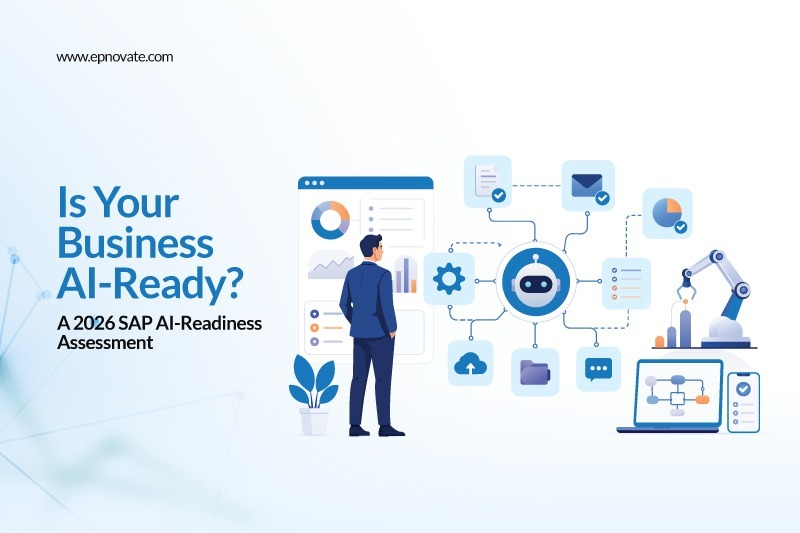
Artificial intelligence is becoming a bigger part of the SAP ecosystem, but adopting AI is not as simple as switching on a new feature. So, how do you know if your business is ready for SAP AI?
The answer starts with your technology foundation, data quality, business processes, people, governance, and the use cases you want AI to solve. This is what SAP AI readiness really means.
As SAP advances its vision for the autonomous enterprise through capabilities such as Joule, Business AI, and increasingly intelligent business processes, organizations need to ask a practical question before investing: Is our SAP environment ready to support AI effectively?
This guide provides a practical SAP AI readiness assessment you can use to evaluate where your organization stands and identify what needs to happen next
Why SAP AI Readiness Matters in 2026
AI can create significant value when it is connected to reliable enterprise data, standardized processes, and the right technology environment. Without those foundations, however, even sophisticated AI capabilities may produce limited results.
For many businesses, the challenge is not a lack of interest in AI. It is a lack of readiness.
Organizations may be dealing with:
- Legacy ERP Systems: Older SAP environments may not support the same embedded AI capabilities available in newer SAP platforms.
- Fragmented Data: Customer, supplier, material, and financial data may exist across disconnected systems with inconsistent standards.
- Customized Processes: Heavy customizations can make it harder to introduce standardized, AI-enabled workflows.
- Limited Governance: Businesses may not yet have clear ownership for AI decisions, data usage, security, or compliance.
- Unclear Use Cases: Teams may be experimenting with AI without identifying a specific business problem or measurable outcome.
This is where readiness becomes more important than enthusiasm. Investing in AI before addressing foundational gaps can lead to unsuccessful pilots, unnecessary spending, and limited adoption.
An AI-ready enterprise does not necessarily need every AI capability on day one. It needs the right foundation to adopt those capabilities in a controlled and measurable way.
The 5 Pillars of SAP AI Readiness
A practical SAP AI readiness assessment should look beyond technology. Five areas determine whether an organization can successfully adopt and scale AI.
1. Platform Readiness
What good looks like: Your organization is already running SAP S/4HANA or has a defined roadmap for moving from its current SAP environment to a modern platform that supports its AI strategy.
Your underlying SAP architecture matters because AI capabilities vary across SAP products, deployment models, and releases. Organizations still running legacy ECC environments should assess which AI capabilities are available today and what a future migration to S/4HANA would enable.
Self-check: Are you on SAP S/4HANA, or do you have a realistic migration roadmap with defined timelines and priorities?
2. Data Readiness
What good looks like: Business data is accurate, governed, accessible, and consistent across relevant systems.
AI depends on the quality of the information it receives. Duplicate customer records, incomplete material data, inconsistent supplier information, and disconnected databases can reduce the reliability of AI-generated insights and recommendations.
Your organization should have clear processes for data ownership, quality management, access, and governance.
Self-check: Can your teams trust the master and transactional data that an AI system would use to make recommendations?
3. Process Readiness
What good looks like: Core business processes are standardized, documented, and sufficiently aligned with a clean-core approach.
AI agents and intelligent automation work best when the underlying processes are clear and predictable. If every business unit follows a different workflow or relies heavily on undocumented manual workarounds, introducing AI becomes more difficult.
Before automating a process, understand how it works today and where decisions actually happen.
Self-check: Are your core SAP processes standardized enough for automation or AI agents to act within defined boundaries?
4. People and Governance Readiness
What good looks like: Your organization has clear ownership, employee support, security controls, and governance policies for AI adoption.
AI implementation is not only an IT project. Business teams need to understand how AI will affect their workflows, while leadership needs visibility into risks, costs, and expected outcomes.
Governance should also address areas such as:
- Ownership: Who is accountable for each AI-enabled process?
- Security: Who can access AI features and the underlying data?
- Human Oversight: Which decisions require human review?
- Compliance: What regulatory and organizational requirements apply?
- Change Management: How will employees be trained and supported?
Self-check: Do you have the people, policies, and governance structure required to use AI responsibly?
5. Use-Case Readiness
What good looks like: You have identified a specific business problem where AI can deliver measurable value.
Being AI-ready does not mean deploying AI everywhere. It means knowing where AI can make a meaningful difference.
A strong first use case should have a clear business owner, accessible data, measurable outcomes, and manageable implementation complexity.
Self-check: Can you name one high-value SAP process where AI could improve cost, speed, accuracy, productivity, or customer experience?
The SAP AI-Readiness Checklist
Use the following checklist for a quick self-assessment. Answer Yes or No to each question.
Platform
- Are you currently running SAP S/4HANA or following a defined migration roadmap?
- Is your SAP environment sufficiently modern and integrated to support your AI priorities?
Data
- Is your master data accurate, complete, and governed?
- Can relevant data be accessed consistently across your SAP and connected systems?
Processes
- Are your core business processes standardized and documented?
- Have you reduced unnecessary customizations and manual workarounds where possible?
People and Governance
- Do you have executive sponsorship for AI adoption?
- Are security, compliance, data access, and human oversight requirements defined?
- Do your teams have the skills required to implement and manage AI-enabled processes?
Use Case and Investment
- Have you identified a specific AI use case with a clear business owner?
- Have you defined success metrics and expected business outcomes?
- Is there a realistic budget and implementation roadmap for the initiative?
The more confidently you can answer Yes, the stronger your foundation for SAP AI adoption. Multiple No answers do not mean AI is off the table. They identify the areas that need attention first.
Score Yourself: Where Does Your Business Stand?
You can use your checklist responses as a simple directional assessment.
Not Ready
What it means: Several foundational areas such as platform, data, governance, or use-case definition need attention.
What to do next: Focus on closing the most critical foundation gaps before launching major AI initiatives.
Foundation-Building
What it means: Your organization has several important capabilities in place but still has gaps that could affect AI adoption or scalability.
What to do next: Prioritize your highest-impact gaps, establish a phased roadmap, and validate one practical AI use case.
AI-Ready
What it means: Your organization has a modern platform, reliable data, defined processes, appropriate governance, and a clear business case for AI.
What to do next: Begin with a controlled, measurable use case and establish a roadmap for scaling AI across additional processes.
This score is a starting point rather than a formal certification. The objective is to identify what your organization should address before increasing its AI investment
Common SAP AI Readiness Gaps and How to Close Them
Even organizations with mature SAP environments can have gaps that need to be addressed before scaling AI.
Still Running on ECC
If your organization relies on SAP ECC, evaluate how your current landscape aligns with your long-term AI strategy. A structured migration to S/4HANA may become an important part of building a modern foundation for future SAP capabilities.
Poor-Quality Master Data
AI cannot compensate for unreliable business data. Start with data profiling, cleansing, standardization, ownership, and governance before relying on AI-generated insights.
No Clear Business Use Case
Avoid starting with technology and searching for a problem afterward. Identify a process where AI can address a measurable business challenge, then define the expected outcome.
Limited Internal Skills
AI adoption requires a combination of SAP, data, process, security, and change-management expertise. If those capabilities are not available internally, an experienced SAP partner can help bridge the gap.
No Governance Framework
Define who can deploy AI, which data can be used, where human approval is required, and how AI outcomes will be monitored before scaling adoption.
Benefits of Getting AI-Ready Now
Building your AI foundation before widespread adoption can provide several practical advantages.
Faster Adoption: A modern and governed foundation makes it easier to introduce new AI capabilities as they become relevant.
Lower Implementation Risk: Addressing data, process, and governance gaps early reduces avoidable problems during deployment.
Better ROI: Starting with a defined business case helps connect AI investment to measurable outcomes.
Phased Transformation: Businesses can move from one validated use case to broader adoption instead of attempting a high-risk big-bang rollout.
Greater Agility: A prepared SAP environment can adapt more easily as AI capabilities and business requirements evolve.
Future Readiness: Strong platform, data, process, and governance foundations position organizations to take advantage of increasingly autonomous enterprise processes.
The goal is not to become AI-ready overnight. It is to build a foundation that allows your organization to adopt AI at the right pace and for the right reasons.
Conclusion
SAP AI readiness is measurable. It comes down to five practical areas: platform, data, processes, people and governance, and use cases.
Before investing in an AI initiative, assess each area honestly. If your organization is not ready, identify the gaps and address them in the right order. If the foundation is already strong, start with a focused use case, measure the results, and build from there.
Epnovate helps organizations assess their SAP landscape, strengthen their transformation foundation, and prepare for intelligent enterprise adoption. With 100+ clients, 55+ developers, and a 4.9/5 rating, Epnovate brings SAP expertise to organizations planning their next stage of transformation.
Ready to find out where your business stands? Book a free SAP AI-Readiness Assessment with Epnovate
Frequently Asked Questions
What does SAP AI readiness mean?
SAP AI readiness refers to an organization’s ability to adopt and scale AI effectively across its SAP environment. It includes platform readiness, data quality, process maturity, people and governance, and having clearly defined AI use cases.
Do I need S/4HANA to use SAP AI?
Not necessarily for every AI capability. SAP AI capabilities vary based on the product, release, deployment model, and use case. However, organizations planning broader adoption of embedded SAP AI should evaluate their current SAP landscape and determine whether an S/4HANA transformation is part of their long-term roadmap.
How do I assess if my business is ready for SAP AI?
Start by evaluating five areas: your SAP platform, data quality, business processes, people and governance, and AI use cases. A structured SAP AI readiness assessment can help identify gaps and prioritize the actions required before implementation.
What’s the first step toward becoming AI-ready in SAP?
Start with a business-led assessment rather than selecting an AI tool. Identify your current platform, evaluate data and process quality, establish governance requirements, and select one high-value use case with measurable success criteria.
How long does it take to get an SAP system AI-ready?
There is no single timeline. The effort depends on your SAP landscape, data quality, process maturity, integration requirements, and chosen use case. An organization with a modern S/4HANA environment and governed data may be able to start sooner, while businesses with legacy systems or significant data gaps may need a longer foundation-building phase.