What is the SAP Business AI Platform? In plain terms: it is the single unified foundation SAP announced at Sapphire 2026, pulling together SAP Business Technology Platform, SAP Business Data Cloud, and AI Foundation into one coherent architecture. Not a rebrand. Not a product rename. A structural consolidation that changes how enterprises build, run, and govern AI across their SAP landscapes.
For years, enterprises have assembled AI capabilities from separate toolkits, one platform for building extensions, another for managing data, a third for AI models.
That worked well enough before AI agents arrived. But agents need all three things at once, in the same place, governed consistently. The SAP Business AI Platform is SAP’s answer.
If you are running S/4HANA, planning a move to it, or just trying to understand where SAP’s AI strategy is heading, this is the announcement that matters most right now.
What Is the SAP Business AI Platform?
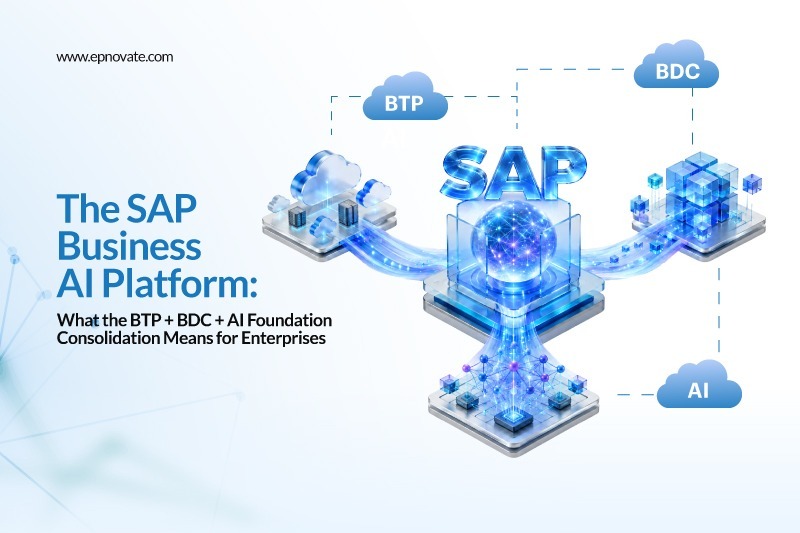
Think of it as a three-layer stack, where each layer handles a different piece of the enterprise AI challenge.
- At the Bottom Sits SAP Business Technology Platform (BTP): The foundation for building, extending, and integrating applications. BTP handles the development environment, the security and identity layer, and the integration fabric that connects SAP and non-SAP systems.
- In the Middle Sits SAP Business Data Cloud (BDC): The governed data layer. BDC consolidates SAP Datasphere, SAP Analytics Cloud, and SAP’s curated business content into a single platform that ensures the data feeding your AI agents is clean, contextualised, and traceable.
- At the Top Sits AI Foundation: The AI and model layer. This includes SAP’s domain-specific models trained on decades of ERP data, Joule Studio 2.0 for building custom agents, the SAP Knowledge Graph that encodes process knowledge in machine-readable form, and SAP AI Agent Hub for governing agents across the enterprise.
Together, these three layers form the platform that powers Joule, SAP’s AI copilot, and the broader Autonomous Suite SAP is building toward. The platform is not just a technical construct.
It is SAP’s bet that enterprise AI lives or dies on three things: trustworthy data, deep business context, and proper governance. All three now sit under one roof.
Why SAP Consolidated Three Platforms Into One
The fragmentation problem was real. Before this consolidation, an enterprise wanting to build a working AI agent needed to coordinate three separate conversations: with their BTP team for the development environment, with their data team for governed data via Datasphere or SAC, and with their AI team for model access and orchestration. Each handoff was a delay. Each seam was a governance gap.
AI agents made this untenable. An agent that automates procurement approvals, for example, needs to read purchase order data, understand business rules, execute a workflow, and log every decision for audit. That requires governed data, business context, orchestration, and compliance controls, simultaneously. Stitching three platforms together to deliver that is slow, fragile, and expensive to maintain.
The payoff SAP is targeting is faster time-to-value for Business AI. When the data layer, the AI layer, and the development layer share the same architecture, the path from “we want an AI agent” to “the agent is live and auditable” is shorter. That is the pitch, and it is a credible one, provided enterprises have the foundation to take advantage of it.
Inside the Platform: The Building Blocks Enterprises Should Know
Here is what actually sits inside the SAP Business AI Platform, and why each piece matters:
SAP Knowledge Graph
SAP’s Knowledge Graph encodes 50 years of SAP ERP engineering, business objects, process relationships, and industry-specific rules into machine-readable semantic relationships. It is the context layer that stops AI from giving generic answers and grounds it in how your business actually works. When Joule recommends an action, it draws on this graph to ensure the suggestion is process-aware and clean-core-compliant.
SAP Business Data Cloud
BDC is the governed data foundation. It consolidates Datasphere, SAP Analytics Cloud, and curated business content, with Master Data Governance built in. This matters because AI agents are only as reliable as the data they consume. If your agent is reading inconsistent or ungoverned data, the output will be wrong, and in an enterprise context, wrong can be costly. BDC ensures every data product feeding an agent has lineage, governance, and a single version of truth.
Learn more about SAP Analytics Cloud vs. SAP Datasphere: Which Is Right for Your Enterprise?
AI Foundation & SAP Domain Models
Rather than relying on generic large language models, SAP has trained domain-specific models on transactional ERP data. These models understand the difference between a goods receipt and an invoice, between a cost centre and a profit centre. They generate answers that are business-accurate, not just linguistically plausible. The Generative AI Hub within AI Foundation also provides access to third-party models via a governed interface, so enterprises are not locked into SAP’s models exclusively.
Joule Studio 2.0
Joule Studio is where custom agents get built and deployed. The updated 2.0 release integrates with n8n for visual workflow design, Vercel for UI tooling, and NVIDIA OpenShell for secure agent runtimes. Developers and business analysts can build agents without deep AI expertise; the platform handles the model access, the data connections, and the compliance guardrails.
Agent Orchestration & AI Agent Hub
AI Agent Hub, announced for Q3 2026 general availability, is the central governance layer for agents across the enterprise. It supports discovery, monitoring, and management of agents, including agents built by SAP partners, with over 680 submissions from the partner ecosystem already logged. Agent-to-agent (A2A) communication and Model Context Protocol (MCP) support mean agents can coordinate across SAP and non-SAP systems without custom integration work for each handoff.
What the Consolidation Means for Your Business
For most enterprises, the practical impact comes down to four things:
- Less integration overhead. One platform instead of three means fewer seams, fewer custom connectors, and a simpler vendor conversation.
- Auditable AI. Because data, context, and governance live in the same architecture, every agent action is traceable. That matters for finance, procurement, and compliance use cases where audit trails are non-negotiable.
- A cleaner path from pilot to production. Fragmented tooling is one of the main reasons enterprise AI pilots stall. A unified platform removes the integration bottleneck that kills momentum after proof of concept.
- Future-aligned development. Extensions and custom agents built on the SAP Business AI Platform sit on the same foundation SAP is actively investing in. BTP customisations built on proprietary silos become liabilities; those built on this platform become assets.
BTP vs the SAP Business AI Platform: What Changes for Existing Users
BTP is not going away. Let that land clearly before anything else.
SAP confirmed at Sapphire 2026 that BTP became the governed foundation of the SAP Business AI Platform, not a casualty of it. Existing BTP investments carry forward. Your integrations, your extensions, your custom applications, they remain valid and, in many cases, become more valuable because they now sit inside a larger, AI-ready architecture.
What changes is the framing. BTP was previously positioned as a platform for building extensions and integrations. It is now positioned as the development and runtime foundation of an AI platform. That shift may affect how you prioritise projects, how you staff capabilities, and how you sequence your roadmap.
The honest qualifier: getting full value from the SAP Business AI Platform assumes you are on S/4HANA with clean, governed data. If you are still on ECC, the platform’s capabilities are largely out of reach. That is not a new problem, but it is now a more urgent one.
How to Prepare for the SAP Business AI Platform
The good news is that readiness for the SAP Business AI Platform is the same as readiness for modern SAP in general. If you are already on that path, you are already building the foundation. If you are not, here is where to start:
- Get to S/4HANA, or plan your path there. The platform’s value is built on a modern core. ECC enterprises need a clear migration roadmap before they can realistically adopt Business AI at scale.
- Clean and govern your data first. SAP Business Data Cloud is powerful, but it cannot fix bad source data. Master data quality and governance need to be sorted before agents go anywhere near production.
- Identify one high-value agent use case. Start with a specific, bounded problem: invoice matching, procurement approvals, financial period close, rather than trying to deploy AI everywhere at once. Prove the value, then scale.
- Work with an experienced SAP partner to sequence it. The platform is new. The right sequencing of BTP readiness, BDC adoption, and AI agent deployment depends on your current landscape. An experienced partner who has seen multiple implementations will save you months of trial and error.
Conclusion
The SAP Business AI Platform is a genuine shift in how SAP packages its technology. By consolidating BTP, SAP Business Data Cloud, and AI Foundation into one unified architecture, SAP has removed the fragmentation that was slowing enterprise AI adoption. The result is a platform where governed data, deep business context, and agent orchestration live together, which is exactly what reliable Business AI requires.
But the platform’s value is conditional. Getting there requires a modern ERP core, clean data, and a deliberate sequencing strategy. Those prerequisites are not new, but the urgency around them just went up.
Epnovate has been helping enterprises navigate SAP transformations since 2016. With 55+ certified developers, 100+ client implementations, and a 4.9/5 client satisfaction rating, we are a Trusted SAP Partner with direct experience across S/4HANA migrations, BTP implementations, and data governance programmes.
Ready to assess your readiness for the SAP Business AI Platform? Book a free consultation with Epnovate’s certified SAP team and get a clear picture of what your path to Business AI actually looks like.
Frequently Asked Questions
What is the SAP Business AI Platform?
The SAP Business AI Platform is a unified architecture announced at SAP Sapphire 2026 that consolidates SAP Business Technology Platform (BTP), SAP Business Data Cloud (BDC), and SAP AI Foundation into a single stack. It is designed to give enterprises one place to build, run, and govern AI agents with embedded business context, governed data, and compliance guardrails.
Is SAP BTP being replaced by the SAP Business AI Platform?
No. SAP confirmed that BTP is not being replaced; it is now the foundational layer on which the SAP Business AI Platform sits. Existing BTP investments, integrations, and custom extensions remain valid and carry forward into the new architecture. The positioning of BTP has evolved, but the platform itself is more central to SAP’s strategy than ever.
What is the difference between SAP Business Technology Platform and SAP Business Data Cloud?
SAP Business Technology Platform (BTP) is the development and integration foundation, the environment where applications are built, extended, and connected. SAP Business Data Cloud (BDC) is the governed data layer; it consolidates Datasphere, Analytics Cloud, and curated business content to ensure the data feeding your AI agents is clean, consistent, and traceable. In the SAP Business AI Platform, BTP is the base, and BDC sits on top of it as the context and data layer.
Do I need S/4HANA to use the SAP Business AI Platform?
In practice, yes. The platform’s AI capabilities, particularly the SAP Knowledge Graph and domain-specific AI models, are designed around S/4HANA’s data model and clean-core principles. Enterprises still on SAP ECC can access some BTP capabilities, but the full value of the Business AI Platform, including AI agents and Joule, assumes a modern S/4HANA core with governed data.
What is the SAP Knowledge Graph’s role in the platform?
The SAP Knowledge Graph encodes 50 years of SAP ERP process knowledge, business objects, relationships, and industry-specific rules into machine-readable semantic form. It acts as the context layer that grounds AI outputs in real business logic rather than generic internet knowledge. When Joule or a custom agent makes a recommendation, the Knowledge Graph ensures that recommendation is aligned with how SAP processes actually work, making outputs more accurate and compliant.
What is Joule Studio 2.0?
Joule Studio 2.0 is SAP’s AI-first development environment for building and deploying custom AI agents within the SAP Business AI Platform. It integrates with n8n for visual workflow design, Vercel for front-end tooling, and NVIDIA OpenShell for secure agent runtimes. It is targeted at both developers and business analysts who need to build domain-specific agents without deep AI infrastructure expertise.