Here is a number that should get your attention: SAP will end mainstream support for ECC in 2027.
That means no more security patches, no legal updates, and no new features for the millions of businesses still running on legacy SAP ECC.
The clock is ticking, and yet, as of mid-2025, only 37% of SAP ECC customers had made the move.
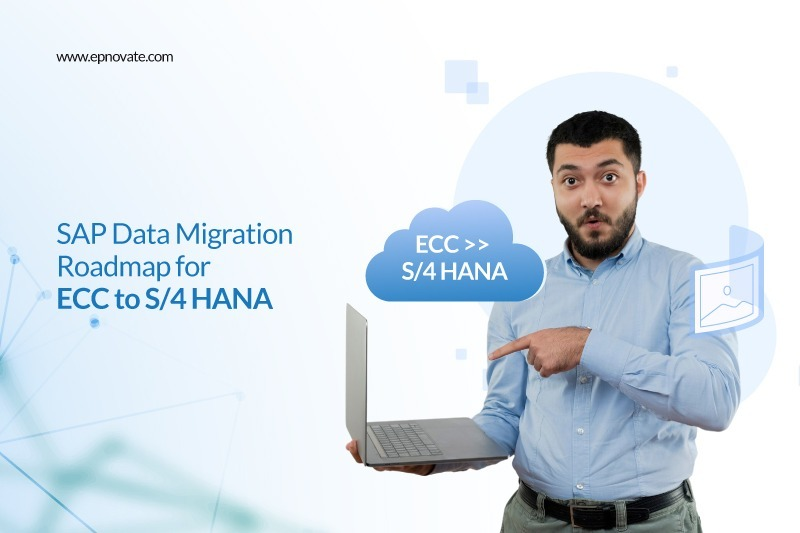
If your enterprise is still on ECC, this roadmap is for you. We will walk through every stage of the migration process, from understanding what SAP data migration actually means to the work that happens after go-live.
Understanding SAP Data Migration
SAP data migration is not just moving files from one server to another. It is a structured process of transferring your business data, master records, transaction history, and configurations from your old SAP ECC system into the new S/4HANA environment.
The reason it requires so much care is simple: S/4HANA runs on a fundamentally different data model than ECC. The underlying database is SAP HANA, an in-memory engine built for real-time analytics and faster processing.
Some ECC data structures no longer exist in S/4HANA. Others have been merged, renamed, or simplified. Moving data without a plan leads to gaps, errors, and expensive rework.
There are three main migration paths to choose from:
- Brownfield: Convert your existing ECC system to S/4HANA, keeping most of your data and configurations in place
- Greenfield: Start fresh with a new S/4HANA implementation, using ECC as a legacy reference
- Hybrid (Shell Conversion): Combine elements of both, ideal for enterprises that want a clean start but cannot afford to lose existing configurations
The right path depends on how much custom code you have, how clean your data is, and how much business disruption you can manage.
Pre-Migration Planning
Every successful migration starts long before any data moves. This phase is about understanding what you have, where you are going, and what stands in the way.
The first thing you should do is run the SAP Readiness Check. This tool scans your current ECC system and gives you a snapshot of custom code volumes, add-ons, simplification items, and compatibility issues.
Think of it as an X-ray of your current setup; it shows you exactly what needs attention before the migration begins.
Key activities in this phase include:
- Define the scope: which business processes and data objects are in, which are out
- Set a realistic timeline: Mid-sized firms typically take 3 to 12 months; complex landscapes can take 18 months or more)
- Assemble your project team: IT leads, functional consultants, business analysts, and executive sponsors
- Choose your deployment model: public cloud, private cloud, or on-premise S/4HANA
- Document your current landscape: interfaces, third-party systems, and custom ABAP programs
Getting executive buy-in here is not optional. Migration touches every part of the business. Without leadership support, the project stalls at the first obstacle.
Data Preparation & Cleansing
Dirty data in, dirty data out. This is where many migrations go wrong: teams rush past cleansing to get to the “real” migration work and end up spending months fixing problems after go-live.
Data cleansing in an ECC to S/4HANA migration typically covers three areas:
- Duplicate removal: Identifying and eliminating duplicate customer, vendor, or material records that would create chaos in the new system
- Standardisation: Enforcing consistent formats, naming conventions, and units of measure across your dataset
- Validation: Checking data against predefined rules to catch missing values, invalid entries, and broken relationships
One area that deserves special attention is Customer-Vendor Integration (CVI). In S/4HANA, customers and vendors are consolidated into a single Business Partner record.
If your ECC data has inconsistencies, missing postal codes, or duplicate tax IDs, the migration tool will stop and flag them. Resolving CVI issues is often the longest and most labour-intensive part of preparation.
Invest time here. Clean data is the foundation for everything else.
Migration Strategy & Tools
Choosing the right tools matters as much as choosing the right strategy. SAP provides several native options for SAP S/4 HANA Migration Services, and third-party solutions fill the gaps for more complex scenarios.
The main tools you will encounter:
- SAP Migration Cockpit (LTMC): SAP’s built-in tool for moving data via predefined migration objects. Best for straightforward scenarios with standard data types
- SAP Software Update Manager (SUM): Used in brownfield conversions to technically convert the ECC system to S/4HANA
- ABAP Test Cockpit (ATC): Analyses custom ABAP code for S/4HANA compatibility issues before migration begins
- Third-party tools like Syniti or IBM InfoSphere: Useful when you have messy data, industry-specific requirements, or high customisation
Match the tool to the task. Simple, standardised data? Stick with SAP’s native toolset. Heavy custom code or a complex multi-system landscape? A specialised tool could save you months of manual work.
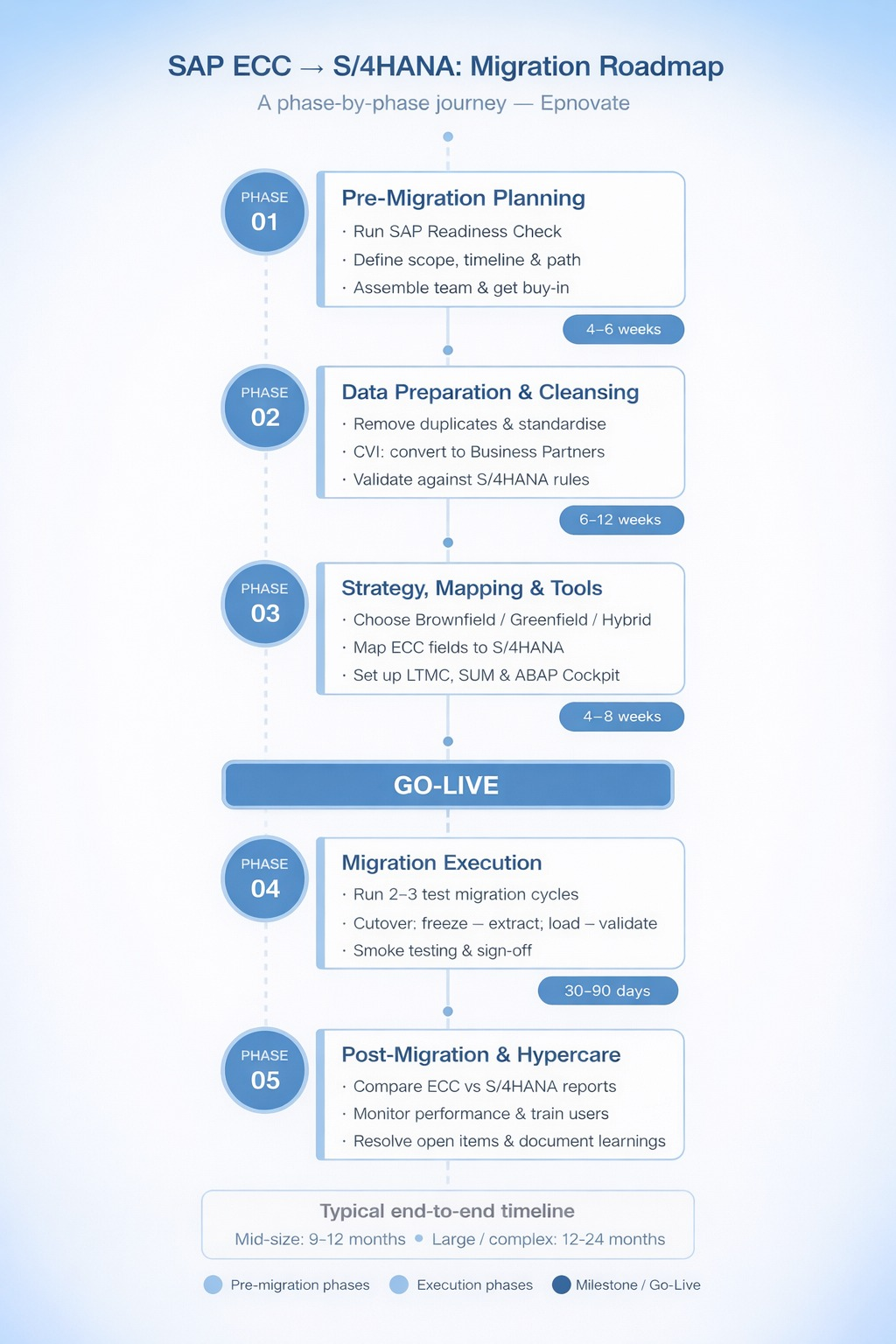
Before we walk through the remaining phases, here’s the full migration roadmap at a glance, from planning all the way through post-migration hypercare.
Data Mapping & Transformation
Data mapping is the process of connecting fields in your ECC system to their corresponding fields in S/4HANA. It sounds straightforward. It rarely is.
S/4HANA’s simplified data model means some ECC tables no longer exist. Others have been merged or restructured. Finance, in particular, sees significant changes; the new Universal Journal in S/4HANA replaces multiple ECC tables, consolidating financial postings into a single source of truth.
What good data mapping looks like:
- Every source field in ECC is matched to a target field in S/4HANA
- Transformation rules are defined for fields that require format changes or value conversions
- Business logic is documented clearly, so both IT and functional teams understand the rules
- Edge cases, legacy data, archived records, and inactive objects are handled explicitly, not ignored
This phase requires close collaboration between your technical team and business owners. Mapping decisions made here directly affect how data looks and behaves in the live system.
Migration Execution
This is the phase where the plan becomes reality. Migration execution is typically split into practice runs and a final cutover.
Before touching the production system, you run test migrations, often two or three rounds, to validate that your data maps correctly, your transformation rules work, and your tools perform as expected.
Each test cycle surfaces issues that need to be fixed before the real migration begins.
The final cutover follows a strict sequence:
- Freeze business operations on the ECC production system
- Extract data from ECC and run final cleansing and transformation
- Load data into the S/4HANA system using your migration tools
- Run validation reports to confirm data completeness and accuracy
- Perform smoke testing, checking key business transactions in the new system
- Get sign-off from business owners before going live
Cutover windows are tight. Most enterprises aim to complete the final migration over a single weekend to minimise business downtime. That timeline is only achievable with thorough preparation in the earlier phases.
Post-Migration Activities
Go-live is not the finish line. The first 30 days after migration are critical for catching issues that only appear when real users work in a live system.
Post-migration work includes:
- Running comparison reports between ECC and S/4HANA to verify data accuracy
- Monitoring system performance and optimising if reports or processes run slower than expected
- User training, even well-mapped data, means nothing if your team cannot navigate the new interface
- Resolving open items, conditions, rebate agreements, and other objects that could not be fully migrated during the technical phase
- Documenting lessons learned to build a playbook for future upgrades
This is also where the right Migration to S/4 HANA partner earns its value. A hypercare period with dedicated support staff on standby means issues get resolved in hours, not days. Small problems caught early stay small.
Conclusion
The ECC to S/4HANA migration is one of the biggest technology moves your enterprise will make this decade. Done well, it unlocks real-time analytics, faster processing, and a foundation built for AI and cloud innovation.
Done poorly, it costs time, money, and operational disruption that can take years to recover from.
The roadmap is clear: plan thoroughly, cleanse your data before anything moves, choose the right tools, map carefully, execute with precision, and stay close to the system after go-live.
You do not have to figure all of this out alone. At Epnovate, we have guided enterprises through every stage of this journey, from the first readiness check to post-migration hypercare.
Frequently Asked Questions
What is the deadline for migrating from SAP ECC to S/4HANA?
SAP will end mainstream support for SAP ECC on December 31, 2027 (for EHP 6-8). After this date, organisations will no longer receive regular security patches, legal updates, or functional improvements.
How long does an ECC to S/4HANA migration take?
SAP suggests the average migration takes between one and one and a half years. Mid-sized organisations with straightforward landscapes can complete it in 3 to 12 months. Large enterprises with complex custom code and multiple system integrations often take longer.
What is the difference between Greenfield and Brownfield migration?
A Brownfield migration converts your existing ECC system to S/4HANA, preserving most of your data, configurations, and custom objects. A Greenfield migration is a fresh S/4HANA implementation where you redesign processes from scratch. The Hybrid or Shell approach combines elements of both, offering a clean slate without losing all existing configurations.
Why is data cleansing so important before migration?
S/4HANA has a simplified and restructured data model compared to ECC. Data that was tolerated in the old system, duplicates, missing fields, and inconsistent formats can cause the migration to fail or produce unreliable results in the new system. Cleansing before migration is far cheaper than fixing data quality issues after go-live.
Do I need SAP S/4 HANA Migration Services from an external partner?
Not every migration requires outside help, but most large-scale projects benefit from it. External SAP migration specialists bring technical expertise, bandwidth, and experience across many different migration scenarios.