Picking the wrong SAP tool can cost your team months of rework. And with two powerful solutions on the table, SAP Analytics Cloud (SAC) and SAP Datasphere, a lot of enterprises end up confused about where to start.
The good news? Once you understand what each tool actually does, the choice gets a lot clearer.
Most experienced SAP Consulting Partners will tell you the same thing: these two solutions are not rivals. They play very different roles in your data setup.
What Is SAP Analytics Cloud (SAC)?
Think of SAP Analytics Cloud as the front end of your data world. It is where your numbers finally show up in a format people can actually use, charts, dashboards, forecasts, and planning models.
SAC is a cloud-based platform that brings together three things in one place: business intelligence, planning, and predictive analytics.
Your finance team can run forecasts. Your sales leaders can track performance in real time. Your executives can walk into a boardroom with live data on the screen.
It is designed with business users in mind, not just IT teams. You do not need a technical background to build a report or explore a dataset. That self-service angle is a big part of why enterprises like it.
Key things SAC is great at:
- Interactive dashboards and data stories
- Financial planning and forecasting
- Predictive analytics powered by AI
- Live connections to SAP and non-SAP data sources
- Mobile access for on-the-go decision making
What Is SAP Datasphere?
Now flip to the other side. SAP Datasphere is what happens before the dashboards. It is the back-end layer where your raw data gets cleaned up, organised, and made trustworthy.
Datasphere was built to solve a problem most large organisations know all too well: different teams using different numbers for the same metric. Marketing says revenue is one figure. Finance says it is another. Datasphere fixes that by creating a single, governed data layer that everyone pulls from.
It connects data from SAP systems like S/4HANA as well as third-party tools, both in the cloud and on-premise. It models that data, applies business logic, and makes it ready for analytics, planning, and AI, all without physically moving everything into one giant storage bucket.
Key things Datasphere handles well:
- Data integration across SAP and non-SAP systems
- Business-context-aware semantic modelling
- Data governance, lineage tracking, and quality management
- Federated data access: connect without copying
- A strong foundation for enterprises modernising from SAP BW
Key Differences: SAP Analytics Cloud vs. SAP Datasphere
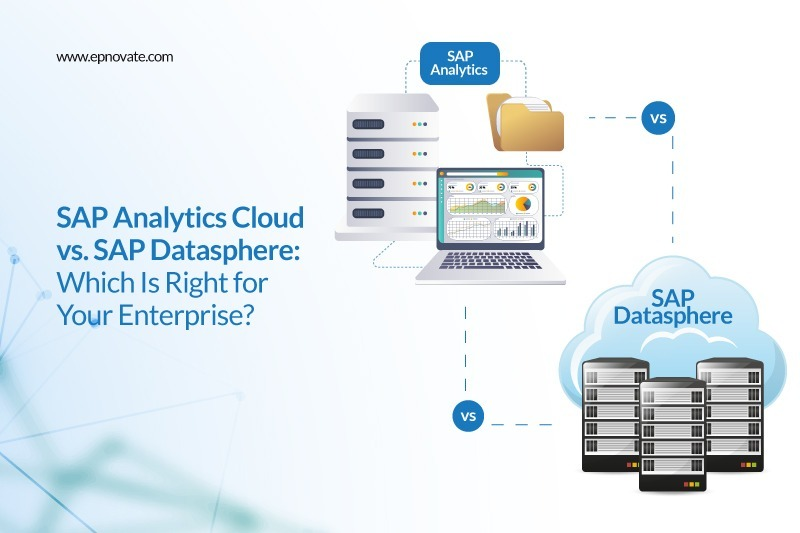
Here is the simplest way to think about it. Datasphere prepares your data. SAC activates it. One is the kitchen. The other is the dining table.
Datasphere sits in the middle, between your source systems and the tools your people actually use. SAC sits at the end of that chain, turning clean, trusted data into decisions.
They are most powerful when they work together. In fact, many enterprise setups run exactly this way: Datasphere models and governs the data, and SAC consumes it for reporting and planning.
Feature Comparison
| Feature | SAP Analytics Cloud | SAP Datasphere |
| Primary Role | Analytics, planning & BI (front end) | Data integration, modelling & governance (back end) |
| Primary Users | Business analysts, finance teams, executives | Data engineers, IT architects |
| Data Storage | Limited: uses live or imported connections | Full data warehousing and modelling |
| Visualisation | Dashboards, digital boardroom, stories | Minimal: designed for back-end modelling |
| Predictive Analytics | Built-in AI and ML capabilities | Feeds trusted data into SAC for predictions |
| Data Governance | Governed via source connections | Rich metadata management and data lineage tools |
| Best Paired With | SAP Datasphere as the back-end layer | SAP Analytics Cloud as the analytics front end |
When to Choose SAP Analytics Cloud
SAC is the right starting point when your organisation already has a decent data foundation and just needs better visibility into it.
Choose SAC if:
- Your business teams need dashboards and reports quickly without heavy IT involvement
- You are running financial planning cycles and want collaborative, driver-based forecasting
- Your leadership team needs real-time, boardroom-ready insights
- You are already on S/4HANA or SAP BW/4HANA and want to activate that data visually
- You need predictive analytics without building a separate AI pipeline
A good example: a CFO team that wants rolling forecasts, scenario modelling, and visual budget tracking does not need a new data warehouse. They need SAC sitting on top of the data they already have.
When to Choose SAP Datasphere
Datasphere is the right move when your data itself is the problem, not just the presentation of it.
Choose Datasphere if:
- Different departments are working from different versions of the same data
- You need to integrate data from both SAP and non-SAP systems into one reliable layer
- You are moving away from legacy SAP BW and need a modern replacement
- Your analytics tools keep returning inconsistent or unreliable results
- You want to build a governed, reusable data foundation that supports analytics, planning, and machine learning
A useful example: an IT team managing data from three ERPs, a CRM, and a third-party logistics platform needs everything to speak the same language before any dashboard can be trusted. That is Datasphere territory.
When you work with the right SAP Support Partners, they can assess your current data architecture and tell you exactly where Datasphere fits into your roadmap, so you are not building on a shaky foundation.
Conclusion: You Might Need Both
Here is the thing most comparison guides miss, for many enterprises, the answer is not SAC or Datasphere. It is SAC and Datasphere.
Datasphere gives you clean, governed, semantically rich data. SAC turns that data into real-time reports, forecasts, and decisions your teams can act on. Together, they form a complete data-to-insight stack built to scale.
If you are not sure where your organisation sits right now, or which solution to prioritise first, the best move is to talk to people who have done this before. At Epnovate, our team helps enterprises map their current data landscape and design the right path forward, whether that means starting with SAC, building out Datasphere first, or rolling out both in a phased approach.
Ready to build a smarter SAP data strategy? Talk to our certified SAP experts and get a clear, honest assessment of what your enterprise actually needs.
Frequently Asked Questions
1. What is the main difference between SAP Analytics Cloud and SAP Datasphere?
SAP Analytics Cloud is a front-end platform for business intelligence, dashboarding, and financial planning. SAP Datasphere is a back-end data management platform that integrates, models, and governs data from multiple sources. SAC activates data for decisions; Datasphere makes that data trustworthy first.
2. Can SAP Analytics Cloud and SAP Datasphere work together?
Yes, and they are designed to. In most enterprise setups, Datasphere acts as the governed data foundation, and SAC consumes its models for reporting and planning. Together they form an end-to-end data stack, from raw integration to boardroom-ready insights.
3. Which should I implement first: SAC or Datasphere?
It depends on your current situation. If you have clean, reliable data and just need better visibility, start with SAC. If your data is inconsistent or scattered across too many systems, start with Datasphere to build a solid foundation. A qualified SAP partner can assess your setup and recommend the right sequence.
4. Is SAP Datasphere replacing SAP BW?
SAP Datasphere is considered the modern evolution of SAP BW for public cloud environments. Many organisations run both in parallel during a transition period, using Datasphere to gradually modernise their data architecture at a manageable pace.
5. Do I need an SAP partner to implement these tools?
While both tools offer user-friendly interfaces, enterprise-level implementations, especially those involving data governance, hybrid environments, or S/4HANA integration, benefit greatly from experienced guidance. Working with certified SAP Consulting Partners reduces implementation risk and helps you avoid expensive missteps.